Changing the Lens: How I Learned to See Asaf Differently
- abigail0269
- Apr 25, 2025
- 4 min read

I recently received and read the report written by the hostel about Asaf. Reading it filled me with questions, reflections, and a deep emotional response—not just about the system, but also about how I used to see Asaf before he began typing. Before I learned to presume competence, I too believed he understood only simple commands; that his eye contact was fleeting; that he was limited in ways he never truly was.
Now, reading those same words in an official report, I realize just how much my perception has changed—and how much still needs to shift in the way we see non-verbal individuals.
The section on Activities of Daily Living (ADL) hit me the hardest. Seeing his disabilities listed in black and white sent a shudder through my body. It’s not that I’m unaware of these challenges—his dyspraxia, his struggles with motor planning, his physical limitations—they are part of his daily life. But I’ve realized something: I don’t really see them anymore as obstacles. They are just part of who Asaf is. They don’t define or limit him in my eyes. I focus more on his strengths, on his spirit, on his humor and sensitivity. I’m learning to work with his challenges rather than against them, to honor his rhythm instead of trying to change it. And it’s changing me, too.
Then I moved on to the sections about his behaviour and communication. I read them, and I couldn’t believe they were describing the same person.
According to the report, Asaf “understands simple commands.” In reality, Asaf understands everything I say to him. He doesn’t always respond—but he understands. The difference is in presuming competence. I used to believe what the report says—before he began typing, before I saw him for who he truly is.
The report states that Asaf “makes little eye contact.” Yes, there are moments when he avoids eye contact, like many of us do. But in real interactions—especially with those he trusts—his eye contact is present, sustained, and intentional.
It also says that Asaf struggles to form relationships with his fellow residents. But when I look at the friendships he’s built in Merchavim, with other non-verbal individuals who also type, I see something very different: deep, meaningful, emotionally rich connections.
Their typed conversations reveal emotional depth and genuine care. These are not assumptions or interpretations—these are their own words:
“We are in the same boat.”“I’m here to support you. I understand what you are feeling.”“S is having a hard time”—followed by advice on how to comfort him.
One of Asaf’s friends typed that he’s scared of Passover. Asaf then explained to him that when he feels stressed, he stands in the corner, as it helps him calm himself.
We’ve wondered for so long why he sometimes suddenly gets up and stands in the corner—now we know. Another insight into Asaf’s behaviour that he never had a way to explain before.
The report describes Asaf as sitting in a withdrawn posture, hands over his ears, lost in his own world. But here at home, I see something else. He finds joy in watching interactions, observing life unfold. He enjoys documentaries and TV series, just like any other 24-year-old. And yet, at the hostel, I often found him watching nursery rhymes and cartoons meant for toddlers. When I asked why he wasn’t being provided with age-appropriate content, the staff agreed it was important—but it didn’t change.
Asaf has his own rhythm in life, and I’ve come to realize that expecting him to conform to a fast-paced, structured routine is unfair. The hostel's activities didn’t always interest him. But at home, he’s a different person. He loves walking, being in nature, listening to birds, and simply existing in a space that feels right for him. He goes on long walks multiple times a day, fully immersed in the moment.
He also started attending a new day center. I receive pictures of him smiling, relaxed, and engaged, and my heart swells with relief. Despite his physical challenges, he finds ways to participate in sports groups—and he joined his cycling group for an overnight trip. That filled me with excitement for him. Being part of a group and community that sees him as an equal is vital.
I’m so happy he’s receiving these opportunities. It’s not something to take for granted, and I’m deeply grateful for the incredible volunteers and professionals who make it possible. Their presence and dedication help create experiences that increase the quality of life for individuals like Asaf.
Still, reading this report, I couldn’t help but wonder—did they fail to see him, or was he so depressed that he withdrew completely?
In the end, the answer doesn’t matter.
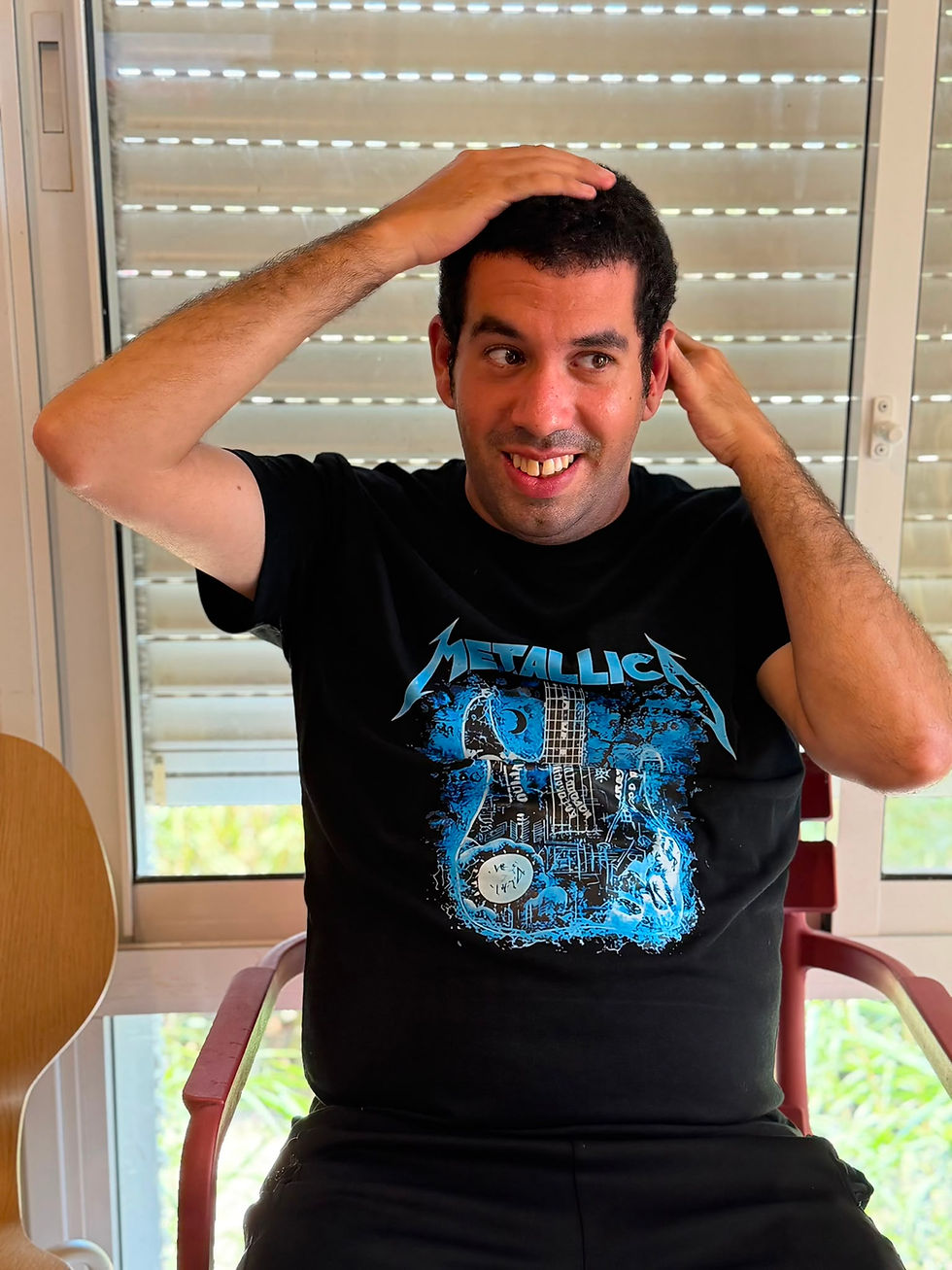
Asaf is home. He is happy. He is gaining weight. He is engaged. He is present.
And that tells me everything I need to know.
His weight loss, his refusal to eat, his lack of motivation—it was all psychological. He was unhappy. Now, in an environment where he is truly seen, we are witnessing the real Asaf.
This realization is freeing and exciting.
This week, Asaf introduced himself to someone through typing, and wrote:
“I’ve returned to life!”
As his mother, I’m so proud that I was able to help give him this opportunity. But I know this isn’t just about Asaf.
This is about every non-verbal individual who has been overlooked, misunderstood, or underestimated.
And I will keep advocating until the world begins to truly listen.



Thank you for sharing. I am in a different time in life with my five year old son who is non verbal, but it reminds me so much of our recent IEP. They spent the majority of the meeting going over test results and telling me how he is in the bottom percentile for basically everything. I spent the majority of the meeting trying not to cry. Looking back after the meeting I knew my emotions were not because what they were saying was true, but because they so clearly don’t see my son for who he is and what he is capable of. It saddens me for our children and there is so much educating to be done.
I feel emotional when I read about this challenging journey of discovery and advancement since Asaf is home. I take my hat off to Abigail and Asaf. Kol hakavod!