Connection Beyond Words
- abigail0269
- Mar 28, 2025
- 3 min read

I spend a lot of time watching Asaf. It’s fascinating to see him drift in and out of what I call his autistic bubble—a space that feels just out of reach, yet so full of depth.
Sometimes, he will spend minutes examining tiny granules of something invisible to my eye. I have no idea what he sees, what holds his attention so completely. Then, suddenly, it’s as if a thought passes through his mind—his face softens, his lips curl into a smile, and before I know it, the smile turns into laughter. His happy noises fill the air, and I’m left wondering:
What was that thought?
What secret joy did he just experience?
I spend hours reading through his conversations trying to get a deeper understanding of his thoughts, of who he is beneath the silence.
But it’s not just emotions like sorrow or unhappiness that he couldn’t express before.
It’s everything.
His thoughts.
His observations.
His suggestions for situations.
His ideas about the world.
His feelings.
When you live in silence all day, only observing, how many deep insights do you have?
What patterns does he notice that I miss?
What connections does he make that he has no way of sharing?
What would he say if he could freely communicate?
At first, I imagined that this must have been deeply frustrating for him—that all these thoughts were trapped inside, with no way to be spoken.
But then, I remembered something he wrote when he first gained the ability to communicate:
"The chance to communicate came as a real surprise to me."
It made me stop and rethink everything.
Maybe he wasn’t sitting in frustration all those years. Maybe he wasn’t waiting, aching to be understood. Maybe he had simply accepted his reality, lived in peace with it, and found joy in his own way.
And now, suddenly, he was given something he never expected: a voice.
But silence wasn’t always peaceful.
When we discovered just how miserable Asaf was in the hostel, we also realized how much pain he had been carrying.
He wasn’t just sad, he was depressed. He was angry with me, too, for not recognizing his suffering sooner. I saw it in his words as he berated me for leaving him there, for not finding a solution fast enough.
His refusal to eat, his lack of participation in activities—these weren’t random acts. They were messages. Messages of pain, frustration, and longing.
And yet, when he finally had the chance to put it into words, he didn’t just say, I am unhappy. He wrote something far more profound:
“My life has no meaning.”
No mother should ever have to read those words from their child. It shattered me. How long had he felt this way? How often had he been trapped inside his own suffering, unable to fully communicate it?
I kept thinking: How does one self-soothe when you can't share your pain with anyone else?
I didn’t have to wait long for his answer.
“Pictures from my childhood past flood my mind and heal my silence.”
This was how he found comfort. This was his refuge.
I sat with his words for a long time, trying to imagine what those pictures looked like. Were they moments of love? Of laughter? Were they the safety of home? The arms of his family?
Naama worked so hard to help him see the good things in his life, to remind him of the light that still existed. But it was clear: He had been struggling for a long time.
Since moving home, Asaf is a completely different person.
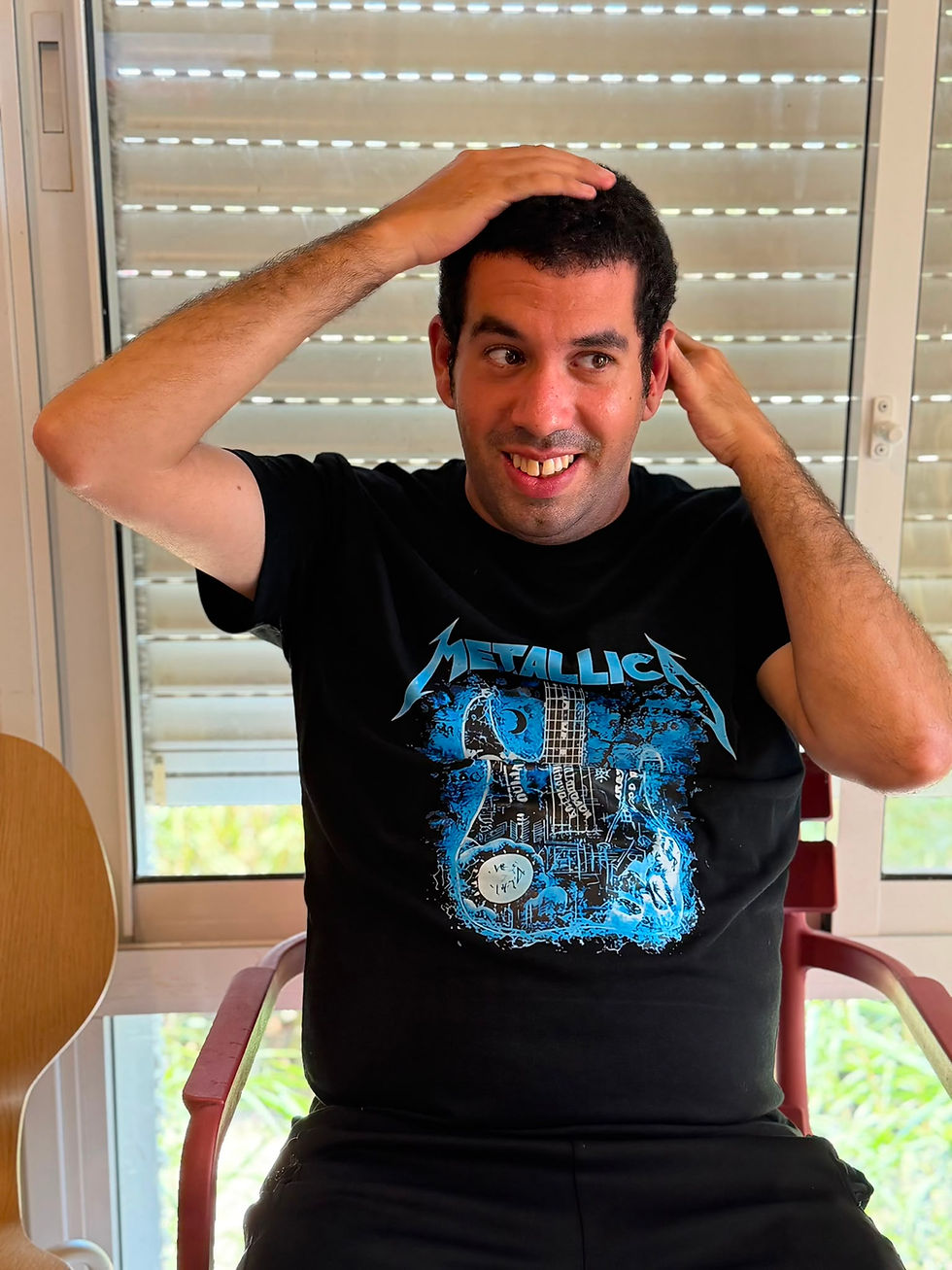
He is visibly happy. More connected. More engaged. It’s as if the weight of his suffering has been lifted, and in its place is something beautiful: contentment.
At home, he’s not just an observer—he’s part of the rhythm of family life. He sits and listens to his siblings laughing, fighting, teasing each other, and he just soaks it all in.
And the best part? He’s truly satisfied.
There are moments when I catch him sitting there, a wide grin on his face, as he takes in the chaos of home. And I wonder—if he could speak, what would he say?
Would he jump into the conversation?
Would he laugh at a joke?
Would he offer his own sharp observations about the people around him?
I don’t know. But what I do know is this: He belongs.
And for the first time in a long time, he knows it, too.
There is so much I still don’t understand about Asaf’s world. But what I do know is that our bond exists far beyond spoken language.
I know he feels my love, even in silence.
I know he hears me, even when words fail.
And I know, in his own way, he is finding his voice.


Comments