From Guilt To Peace
- abigail0269
- Feb 14, 2025
- 3 min read

A recent conversation made me realize something I’ve been struggling with: my focus on Asaf’s challenges has overcrowded my ability to see the bigger picture. It’s not that I’ve failed to see his happiness, but rather that the challenges—the bureaucracy, the responsibilities, his autism, and his stomach issues—have dominated my thoughts, making it hard to focus on his happiness, the joy he brings into our lives and us into his.
My image of him has become blurred, weighed down by my worries and fears. I’ve been so consumed by what’s hard that I’d lost sight of the bigger picture:
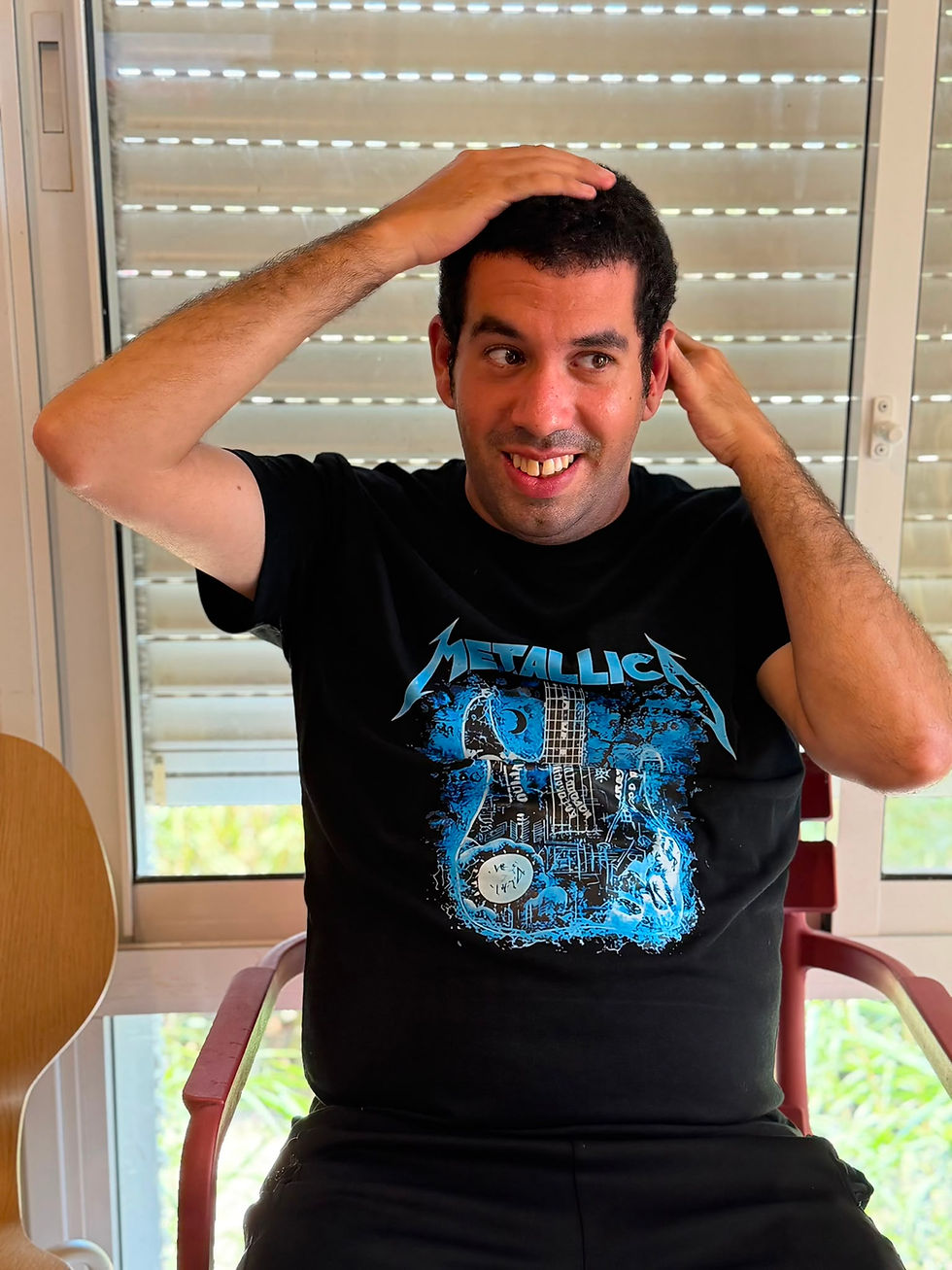
Asaf is home, he’s happy, he’s literally glowing, he’s calm, and he’s content.
As I reflected on this, I began wondering how many other parents of children with special needs share this silent guilt unnecessarily?
For 20 years, I carried around guilt over the dark thoughts I had during the most challenging times of his childhood. In those moments of exhaustion and despair, I sometimes thought about what life would be like if he were no longer alive. Even writing these words makes my body tremble. The desperation was overwhelming. I convinced myself that having these thoughts made me a terrible mother. That somehow, by merely thinking them, I had failed him.
Four years ago, I met a mother who's son had special needs in a workshop. I felt safe enough to share these thoughts. I was astonished to discover that she had felt exactly the same . At that moment, something shifted in me. I realized that these thoughts were not a reflection of my love for Asaf, nor did they make me a bad mother. They were simply the raw, unfiltered reality of deep exhaustion, grief, and the crushing weight of responsibility. Her admission was like a release of 20 years of guilt for me—not just because I wasn’t alone, but because I finally understood that these thoughts are part of our reality as special needs parents. They do not define us. They do not make us unworthy. And most importantly, we do not have to carry the self-blame for having them.
Research shows that guilt and shame are significant predictors of parental stress. However, self-forgiveness can help mitigate these feelings, highlighting the importance of fostering self-compassion as a coping mechanism. A study published on ResearchGate explores how guilt and shame contribute to stress among parents of autistic children, while self-forgiveness can serve as a powerful tool for relief.
Additionally, societal pressure on mothers to "save" their autistic children through endless interventions can deepen feelings of inadequacy and guilt, especially when the desired outcomes are not achieved. Many of us are made to feel that if we just try harder, find the right therapy, or push our children further, we can “fix” them. But this pressure only feeds the guilt, making us believe that if our child struggles, it must be our fault. (Source)
I experienced all of these feelings.
I am learning that Asaf’s happiness is real. The world sees it, and I must allow myself to see it fully too. The guilt I have carried for years does not serve him, and it certainly does not serve me.
To the mothers who carry this silent burden:
You are not alone.
Your love is enough.
Your best efforts are enough.
And perhaps, the greatest gift you can give yourself, and your child, is self-forgiveness.
These words need to be a daily reminder for me, so I am writing them on my mirror where I will see them every morning. If this resonates with you, I invite you to do the same. Write it Say it out loud. Let it sink in. Because we deserve to believe it.



Comments