Talk at Eye Level

There is one question that always makes me shrink inside.
"Do you talk to Asaf normally?"
When I answer, "Yes. I talk to him exactly as I would talk to you," I often get the same surprised response.
"Really?"
Part of me finds that question incredibly frustrating.
I write about Asaf. I share the things he types. I tell people that he is intelligent, thoughtful, funny, sensitive. That he understands what is happening around him.
But I also understand the question.
Because people don't judge Asaf by what I write about him.
They judge him by what they see.
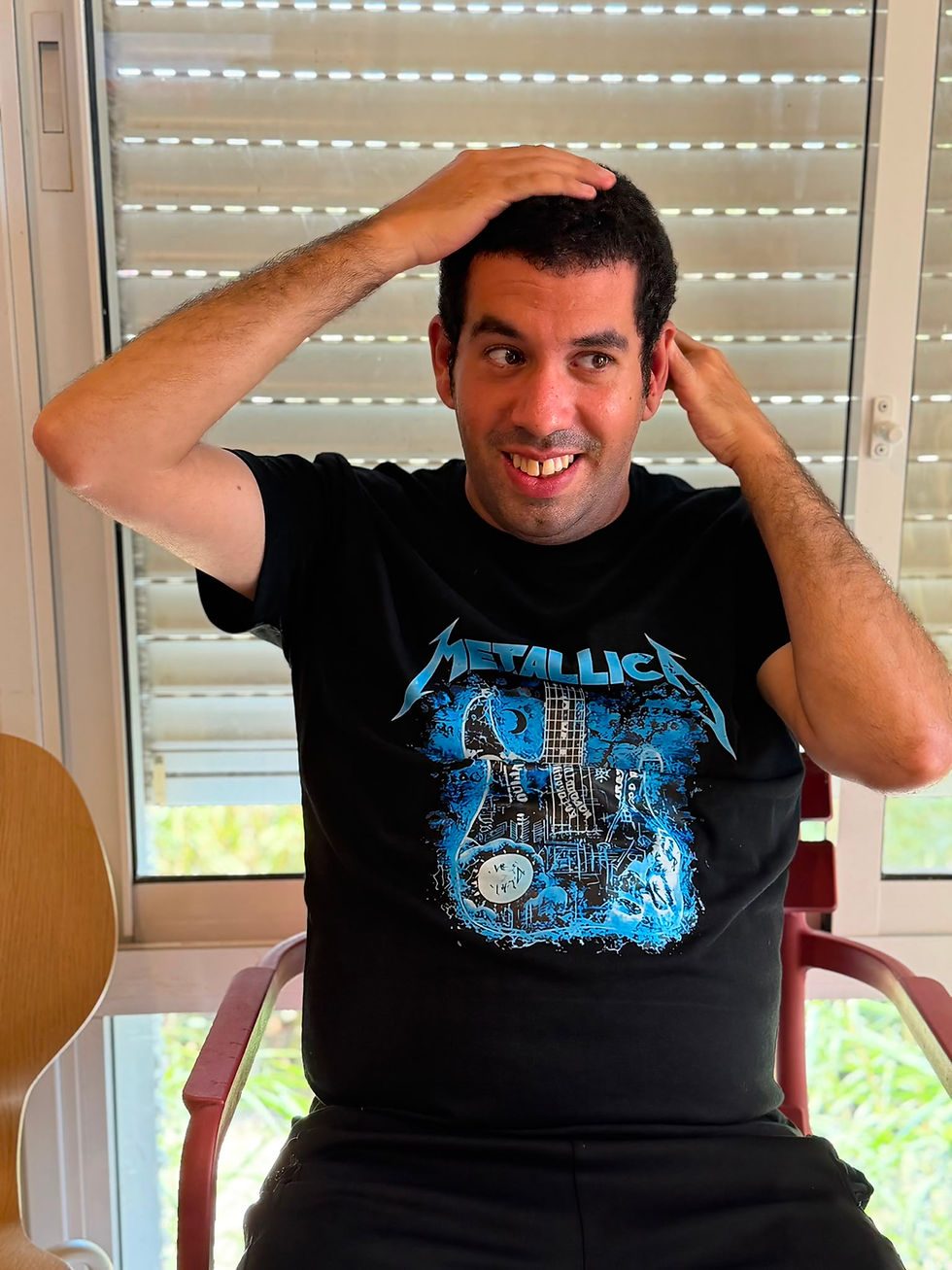
And what they see is a 26-year-old man who looks “different”. By different I meant someone who often appears disconnected. Who may not look at you when you speak to him. Who may make noises instead of answering. Whose face may remain completely blank while you are talking to him.
Sometimes I can be telling Asaf something important, and get absolutely nothing back.
No expression.
No acknowledgement.
No indication that my words have even registered.
And even now, knowing everything I know, there are moments when I have to remind myself:
He's listening. He understands.
So I understand why people get it wrong.
Because I got it wrong too.
For most of Asaf's life, I spoke to him very differently from the way I speak to him today.
I used simple language. Short sentences. I repeated myself four, five, six times.
When he didn't respond, I assumed he hadn't understood.
So I simplified some more. I repeated some more.
I spoke to him as though he were much younger than he actually was.
Not because I didn't love or respect my son, because I genuinely believed his outward behaviour reflected what was happening inside his mind.
Then Asaf began communicating through typing.
And one of the first things he wrote to me was:
"I want you to know that I'm smart in my head."
I have never forgotten those words.
Because Asaf hadn't suddenly become smart when he began typing. He hadn't suddenly started understanding the world around him.
He had finally found a way to tell me.
And those words forced me to reconsider almost everything I thought I knew about my son.
Today I talk to Asaf about everything.
I tell him what's happening in the family. I ask his opinion. I tell him about plans that concern him. I talk to him about things that a 26-year-old man might be interested in.
And every so often, I get a glimpse that reminds me just how much is being received, even when almost nothing is being returned.
A few weeks ago, Asaf typed that he had noticed he'd put on weight, and wanted to start training.
For Asaf, that isn't a simple request.
His gross and fine motor challenges make exercise incredibly difficult. He participates in a running and sports group, but there are many activities his body simply struggles to perform.
I spoke to Ofer, a personal trainer at our gym, about the possibility of working with him.
Later, I told Asaf.
His eyes lit up.
The happy noises started immediately.
There he was.
For a moment, his body gave us exactly the response we expect when somebody hears good news.
Mum heard me. I asked for something and she listened.
But it doesn't always happen that way.
Sometimes Asaf's body seems to tell us the exact opposite of what he actually wants.
Swimming is a perfect example.
Asaf has always loved water. As a child he used to practically live in the swimming pool. He loved the sea .
And yet there have been countless occasions when getting him into the water has been a physical battle.
If you were watching from the outside, the conclusion would seem obvious.
He doesn't want to go in.
Except once he's in, he's happy.
The problem wasn't necessarily the water.
The problem was getting his body to do what his mind wanted it to do.
That is one of the hardest things to understand about Asaf.
Behaviour is the body speaking, but it doesn't always translate the mind perfectly.
And when we don't understand that, we make assumptions.
We assume that because someone doesn't respond, they didn't hear us.
Because they don't look interested, they aren't interested.
Because they don't answer, they don't understand.
Because their behaviour looks childlike, their mind must be childlike too.
And then we start speaking to them accordingly.
I hear it around Asaf all the time.
That voice.
That tone.
The simplified language we so often use when speaking to people with disabilities.
Talking to a 26-year-old man as though he were six.
It has become one of my biggest pet peeves.
But I have walked in those shoes.
And that is why I don't want this piece to be about blame.
I know what people see.
I know how confusing the mismatch between Asaf's body and his mind can be.
I know how easy it is to believe the evidence right in front of your eyes.
What I hadn't fully understood was what it felt like from his perspective.
So before writing this blog, I decided to ask him.
How does it feel when people speak to you as though you don't understand?
His first response was immediate.
"I refuse to answer you for your blog."
That stopped me.
This was obviously not simply a simple question for Asaf.
I had touched something painful.
Eventually, he chose to answer.
He described it as:
“Poking around in an open wound”
And then he wrote that despite every act of disrespect:
“I choose to forgive.”
I keep coming back to those two things.
An open wound.
And:
He chooses to forgive.
I don't think I had truly understood until that moment how deeply being spoken to this way had hurt him.
Because he doesn't show us.
There is no angry response.
No "Don't speak to me like that."
No facial expression that tells the person standing in front of him that their words or their tone have hurt.
But the absence of a visible reaction doesn't mean the absence of pain.
He heard.
He understood.
He felt the disrespect.
And he remembers.
It is an open wound.
And then there is the second part.
He chooses to forgive.
What a beautiful heart and soul my son has.
Because I am included in that forgiveness.
I was one of the people who underestimated him.
I was one of the people who spoke to him as though he were a younger child.
I was one of the people who mistook what his body could show me for what his mind could understand.
And there are people who still speak to him like that today.
He knows.
It hurts.
And somehow, he chooses not to carry the anger.
He chooses to forgive us.
But his forgiveness doesn't make the wound any less real.
And perhaps that is the reason I need to write this.
Not to make anyone feel guilty. Not to point fingers.
But because I was there too. I know how easy it is to get this wrong.
And I also know that once we know differently, we can choose differently.
So if you are a parent, a teacher, a therapist, a caregiver, a sibling, a friend, or simply someone who meets a person like Asaf, I am asking you to do one very simple thing.
Talk at eye level.
Speak to them at their chronological age.
Don't simplify everything just because they don't answer.
Don't use a baby voice because their behaviour looks childlike.
Don't assume that the absence of a response means the absence of understanding.
Talk about things that are interesting.
Explain what is happening.
Include them in conversations.
Give them the dignity of assuming there may be far more happening inside than their body is capable of showing you.
Because you may not see your words land.
You may get no eye contact.
No nod.
No smile.
No answer.
But that doesn't mean nobody is listening.
Asaf has taught me that there can be an entire person behind that silence, hearing, thinking, feeling and understanding.
And sometimes, while we are assuming our words haven't even registered, they have landed deeply enough to leave a wound.
My son chooses to forgive us for the years we got it wrong.
Now it's up to us to choose to do better.


Comments