Trapped in Silence
- abigail0269
- Jul 24, 2025
- 4 min read

This week, I’m writing from a place of deep frustration. Not the fleeting kind that comes and goes, but the kind that sits heavily on one’s chest, and refuses to leave. The kind that builds when you see someone you love stuck, really stuck, with no real way out.
Asaf, my beautiful son, wakes up each day with so much inside him, so much to share, to express, to give. But the window through which he’s allowed to communicate is heartbreakingly small: An hour with his therapist. Two more hours in Merchavim, with friends who converse with each other through typing. THAT’S IT!
The rest of his day? Silence. Stillness. Isolation. He is essentially a prisoner of the mind and body, with no open doors.
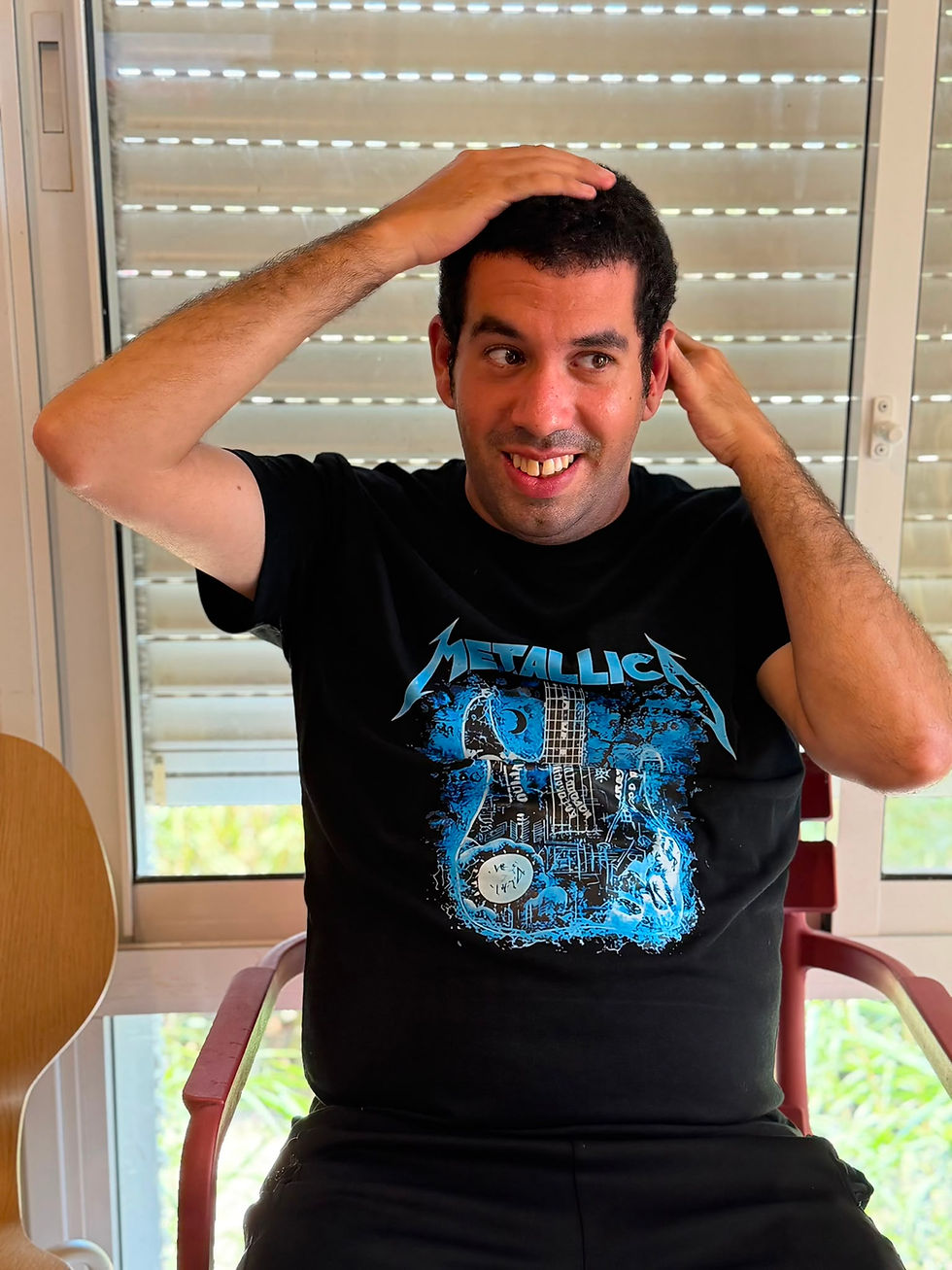
And yet, if you saw him, you might not guess he’s suffering or frustrated. He appears happy. I see it in his body movements, his facial expressions, his laughter, his singing. He radiates joy in those moments, and I hold onto that. But I also know, this has been his world for 24 years. He’s had to get used to living in the prison. He said it himself: “It came as a surprise to have the opportunity to communicate.”
Yes, he laughs. Yes, he sings. But no one should have to get used to being locked inside one’s self. No one should feel surprised when finally be given a chance to be heard. It breaks my heart and I need to accept the situation for what it is.
He has a rich and deep inner world. His mind is sharp, compassionate, and full of ideas. And yet, most of the time, he is locked out of the conversation. That is a kind of cruelty I wouldn’t wish on anyone.
When he was recently interviewed for a short awareness video created by our local authority, he was asked: "What is something you wish you could do, but can't?" His reply was simple and devastating: "I’d like to be able to type anywhere without assistance."
Can you imagine that?Needing permission, needing support, to do the one thing that allows one to exist in the world with others? To share your thoughts, your humor, your anger, your dreams?
This isn’t just a philosophical frustration, it’s a very real, physical danger.
Just this week, Asaf came to his typing lesson and wrote:"I’ve had a headache since last night. I need medicine."
He had been suffering for nearly 20 hours with no way to tell me.I had no way of knowing as he seemed very happy and he had no way to ask for help, for comfort, for basic care. I was devastated and so grateful that he was able to finally share.
And then he shared his deep frustration that he has no proper way to tell me these things when they matter most.
That moment cut deeper than any before. Because it’s not just about being locked out of a conversation. It’s about being locked out of one's basic needs: One’s health. One’s safety, One’s dignity.
I have to find a way to change this. Typing methods MUST become accessible to all non-verbal individuals.
Asaf typed that he sees himself as a freedom fighter for the non verbal autistic community: A voice for non-verbal individuals who are still unseen, still unheard. He is an advocator. Just as I am.
Together, I truly believe we can change the world: One conversation, One moment of typing, One shift in perception at a time.
This week, I carry the weight of this frustration with me. But I also carry determination, to make change happen.
Can you imagine how much richer the world would be if all these smart, intelligent, non-verbal individuals were able to express themselves freely?If their voices were truly heard, respected, and responded to?
How many ideas, emotions, perspectives, and contributions are we missing every single day simply because society hasn’t created the conditions for them to emerge?
It’s time we stop accepting silence as the norm. It’s time we start presuming competence, and building a world where expression isn’t a privilege, it’s a basic right.
I believe this is the time to go in. To go deep. To go wide.
If you're reading this and feel moved: Please help me make this happen.
Help me connect with the people who open doors: Educators. Therapists. Policy makers. Business leaders. Parents. Students.
Invite me to speak. Bring my lecture to your organization, your school, your company, your community.
Let’s keep spreading the notion of presuming competence until it is present in every home, every classroom, every care facility, every mind.
Together, we can change everything.
About the Author:
Abigail Fidler is a lecturer, mother of five, and passionate advocate for presuming competence in non-speaking individuals. Her personal journey took a profound turn when her eldest son Asaf, who is non-verbal and autistic, began to communicate through typing, and she discovered that he has full cognitive abilities. Her lecture, “A Voice from the Silence,” shares their story with honesty, hope, and a powerful call to transform how we view and support non-verbal people.
To invite Abigail to speak or collaborate: Email: abigailfidler10@gmail.com Phone: +972-50-594-4273 Website: www.abigailfidler.com Blog: www.abigailfidler.com/blog



Comments