When Pain Has No Words.
- abigail0269
- May 16, 2025
- 5 min read

For as long as I can remember, I believed Asaf had a very high pain threshold. In 24 years, I’ve rarely seen him cry from pain; and when he did, it meant something truly unbearable was happening. His silence in the face of injury or discomfort became part of the ways I understood him—quiet, strong, distant from the physical world. But was it really a high pain threshold? Or something else entirely?
When Asaf moved into the hostel, a quiet fear took root in me—a fear so specific and intense it startled even me: that I would receive a phone call in the middle of the night telling me that Asaf had died. I didn’t understand why this thought haunted me, but it never fully left.
Then one morning, at 3:45 a.m., my phone lit up with the name of the hostel manager.
In the five seconds it took to answer the call, my heart stopped. My greatest fear felt like it was coming true. When I finally heard her voice, and realized Asaf was alive, the relief made my legs weak. She explained that he had woken up, slipped, and cut his head open. He was being sent to A&E.
I rushed out the door. Minutes later, she called again. After reviewing the security footage, they realized Asaf hadn’t just slipped. He had suffered an epileptic seizure while standing. He fell forward, smashed his head on a doorframe, and landed hard on his face. She offered to show me the video the next day. I said yes. I’m still not sure why.
The 45-minute high-speed drive to the hospital was excruciating. I had to fight the urge to run through every worst-case scenario in my mind. My thoughts raced faster than the car. Every red light, every curve in the road, felt like it was stretching time.
When I arrived, I found Asaf conscious, his head and face caked in drying blood. He was waiting for a sedation so they could perform a CT scan. Somehow, miraculously, he was okay. No concussion. No broken teeth. Just a very swollen lip and seven staples in his scalp.
A couple of hours later, as I drove back home exhausted and shaken, I saw the most beautiful sunrise. The kind that brings you to tears, not because it’s peaceful, but because it arrives after a night you thought might break you.
I called the hostel as soon as I woke up. “He’s sitting in a chair and very quiet,” they said I should expect to find him subdued.
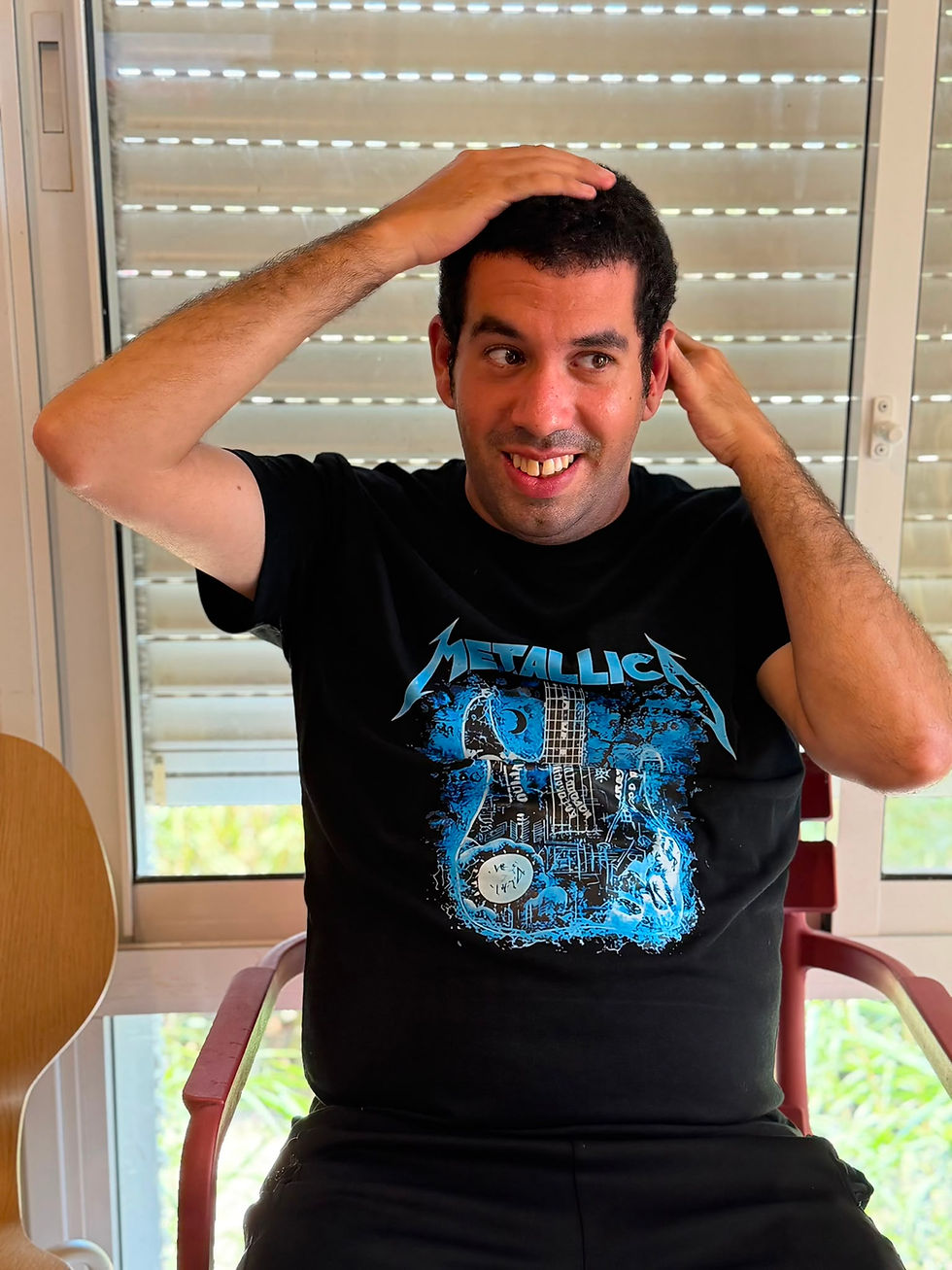
But when I arrived, Asaf lit up when he saw me. He signalled that he wanted to go for a walk. Then a drive. Then to the supermarket, where he chose what he wanted to eat. If it weren’t for the staples and swollen lip. He was behaving as he would on any other visit of mine.
The next day I visited again, still marveling at how “okay” he seemed. That afternoon, he typed: “My head is pounding, I need medicine.”
I stood frozen. Of course his head hurt. Had he not been able to type those words, I would never have known. He didn’t cry, didn’t complain, didn’t show any obvious signs of pain.
Now that I’ve been given a window into Asaf’s inner world—rich, emotional, intelligent, nuanced—I find myself revisiting so many assumptions. His behaviours. His silences. His seeming "tolerance" for pain.
Was it ever about a high pain threshold?
I’ve recently learned that many autistic individuals—especially those who are non-speaking—experience and express pain differently. Studies suggest that while they may feel pain deeply, they often process sensory input in unique ways, or have difficulties expressing distress in ways that others can easily understand. Some may be hypersensitive, others hyposensitive, but almost all face challenges in communicating that something is wrong.
That research resonates with me on a cellular level.
For years, I believed Asaf didn’t feel pain the way we do. Now I wonder if he felt everything, but had no way to show it. Maybe he was screaming internally, and I just couldn’t hear him.
Hidden Pain
After one of Asaf’s hospitalizations, I asked him during a typing session,“Do you have any other medical predicaments we might not even be aware of?”
His answer stopped me cold:“Lots of headaches.”
I had no idea. How could have i known? I let the guilt disappear rejoicing in the knowledge that he finally has a means to communicate his pain.
I made an appointment with our family doctor, who is wonderfully sensitive to Asaf’s needs. I showed her what he wrote. She immediately gave me a list of questions to ask him through typing and suggested we get his eyes tested too.
But how does one test the eyes of a non-verbal person who can’t sit still when stressed and anxious?
After a lot of research, I found an optometrist experienced with autistic individuals. We made an appointment for the following week, after Asaf’s regular typing session.
That day, he sat focused, his determination clear. He answered our questions with visual determination:
“The pain is on the left side of my head, above and below the ear. It hurts most of the day. The light blinds me.”
I asked him ,“Can you give us a sign when you’re in pain so we’ll know and be able to help?”
He answered:
“I hit my head.”
And just like that, a lifetime of confusion came into focus. Yes—Asaf does hit his head. But he never shows any discomfort when he does, so I never connected it to pain. I never imagined it could be a form of communication.
Eventually, we discovered the cause: his ears.
Asaf has very narrow ear canals that had become blocked with wax. Since then, we’ve had his ears syringed four times, each time because he told us he was in pain.
And I keep thinking:
How many times has he suffered in silence? How many times did I look at him and see “behaviors” instead of a body crying out? And how many others, like Asaf, are still suffering—unheard, unseen, misunderstood?
I used to believe that silence meant peace. But now I know that sometimes silence is filled with noise—unspoken needs, unnoticed pain, misunderstood cries for help.
Asaf is showing me, one typed word at a time, how much he has to say—and how much he’s been waiting to be heard.
His voice is now a lifeline. Not just for him, but for me too. I can no longer live in the space of assumptions. I need his truth. I need his words. I need his guidance to truly be the mother he deserves.
And I carry that truth with me into every conversation, every appointment, every behaviour that once seemed “random” or “unexplainable.”
Asaf is speaking.
And I am listening—with everything I have, and everything I am.



Mais um obra de arte