When Silence Holds Fear: Reflections from the Safe Room
- abigail0269
- Jun 26, 2025
- 4 min read

How does one deal with fear when there's no simple way to express it?
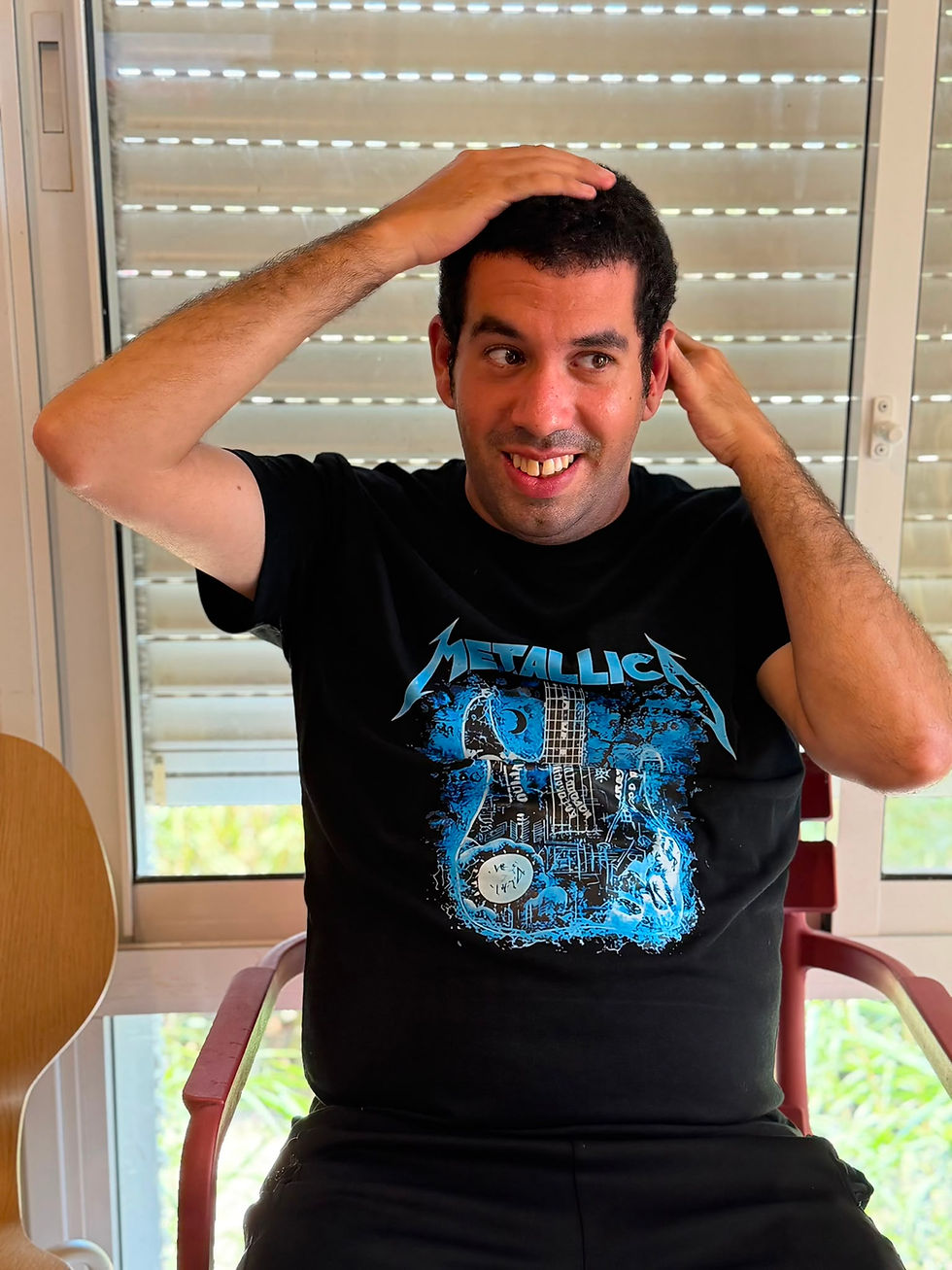
The war with Iran, over the past two weeks, has brought that question into sharp focus for me. Since Asaf began communicating through typing less than 16 months ago, I’ve been discovering the deep contrast between his rich inner world and his external behaviour. This war made that contrast even more obvious.
Dealing with war, missile and drone attacks, sirens piercing the middle of the night, has been frightening, exhausting, and relentless. When that first siren came at 3 a.m., it jolted us out of sleep. I had 1.5 minutes to get to the safe room. In that time, I also had to wake Asaf, help him manoeuvre his body out of bed, and guide him to safety. It’s a huge responsibility. Every night it repeated, sometimes more than once. Confusion, adrenaline, fear and relief, after the all clear was given.
The morning after that first siren Asaf insisted on sitting in the safe room even during quiet times. And in the middle of all the tension, I felt a deep, unwavering sense of gratitude, grateful that he was home with me.
Because he was safe. Because our safe room is within the house. Because I didn’t have to rely on carers rushing him and 35 other people down into a shelter. Because I could explain what was happening. Because I could share my fears. Because I could make sure he knew he wasn’t alone.
And more than anything, I was grateful that he could share his fears with me.
He told me he felt safe staying in the protected room. He typed, clearly and heartbreakingly, that he feared dying from a missile.
Even as I write this, after two weeks of living under existential threat, it still feels unreal. That this is what we’ve had to deal with. That this has been our daily reality. That this is what our children are experiencing.
And yet, through all of this, Asaf was a star. Even after being woken night after night, sometimes more than once, he found the strength to move himself to the safe room. He understood why we had to sit there patiently until the signal came that it was okay to leave. He cooperated, even when exhausted, even when I know his body was screaming for rest.
But there was another layer of pain.
Asaf loves walking in nature. It’s one of his greatest pleasures, two, sometimes three walks a day, filled with joy and calm. And that too was taken from him. There’s a nine minute window between a missile launch and impact. Going for a walk became a dangerous gamble. And if it's a UAV, there's no warning at all. We couldn’t take the risk. His basic joys, those quiet moments of freedom, were ripped away.
That’s not what I want to focus on.
What weighs most heavily on my heart is the dissonance. The impossible contrast between Asaf’s inner world and the way he presents outwardly. It’s so difficult to read him. He has no way, except through typing, to show or share his thoughts and feelings. I can see it in his eyes when he’s stressed. I try to calm him. But I don’t know the thoughts behind those wide, frightened eyes. And as a mother, that is so, so hard to carry.
I do my best, I explain what’s happening, I share my own fears, I name the emotions aloud. But the truth is, I never really know what he is feeling unless he tells me. And even when I sense that he’s overwhelmed, I often have no idea what’s caused it
Then, just as quickly as the war started, it ended. We were told to go “back to normal.”
But what is normal? You can’t just switch off two weeks of hyper-vigilance.You can’t be in a constant state of high alert and then simply resume life as if nothing happened.
First there’s the fear: Will this last? Then the doubt. The dread. The heavy concern about what lies ahead.
And there’s also the sadness.
The unbearable sadness for those who didn’t make it to a safe room in time. For those who lost their homes, their loved ones, their sense of safety. It’s truly devastating.
Even as I hold my gratitude close, for Asaf’s safety, for our safe room, for being together, I can’t ignore the grief that surrounds us. The images. The names. The stories. The knowledge that so many lives were shattered while we were crouched behind reinforced walls, hoping to be spared.
This pain, too, lives alongside the fear.
For twelve days, I’ve been in survival mode, focused on caring for others, trying to function, showing up for work, pretending everything was calm, while my nervous system was at war and a storm raged inside me. (And let’s be honest, staying focused was totally impossible.)
Now I understand, we need time. Time to process what we’ve been through. Time to let the adrenaline release from our bodies. Time to acknowledge what it cost us just to get through each day.
One of the most important things we did once we were told to return to "normal" was to meet with Naama, Asaf’s communication facilitator. We needed that space to talk. To allow Asaf to express what he had been holding in.
That conversation was humbling.
Asaf shared his fears clearly, calmly, with maturity beyond his years.
He said something that broke me, and awed me at the same time:
A burnt match will not reignite.
Some fears, once lit, leave permanent marks. He knows that. He feels that. And yet, he chooses to share. He chooses to let me in. And I am endlessly grateful.
I also came to understand something else, something I had never considered before. Due to his hypersensitivity, Asaf hears sounds that I can’t, and my hearing is also very sensitive. Background noises that I filter out, he absorbs in full intensity. Distant echoes, tiny vibrations, low drones; His world is louder, sharper, more intrusive. No wonder he’s so often flooded by fear. The world literally screams at him.
His fears haven’t vanished. They’re still here. But now, he can speak them. He can give them form. And that’s everything.
Because when fear has no voice, it stays trapped inside the body. But when it’s spoken, even silently, even letter by letter, it begins to loosen its grip.
And that, I believe, is how we begin to heal.



Comments