The Bench That Brings People Together

We often recognise friendship through behaviour.
Two people laughing together.
A hug.
A shared joke.
Friends chatting over coffee.
An invitation to a birthday party.
These are the things that tell us two people care about each other.
But what happens when behaviour is the least reliable thing we have?
What happens when you can't speak?
What happens when you have apraxia, a disconnect between mind and body, where you desperately want to reach out and greet someone, but your body does something completely different?
What happens when, instead of reaching out to say hello, you pull someone's hair or hit them? When your actions don't reflect your intentions, how can anyone know what you're really trying to say?
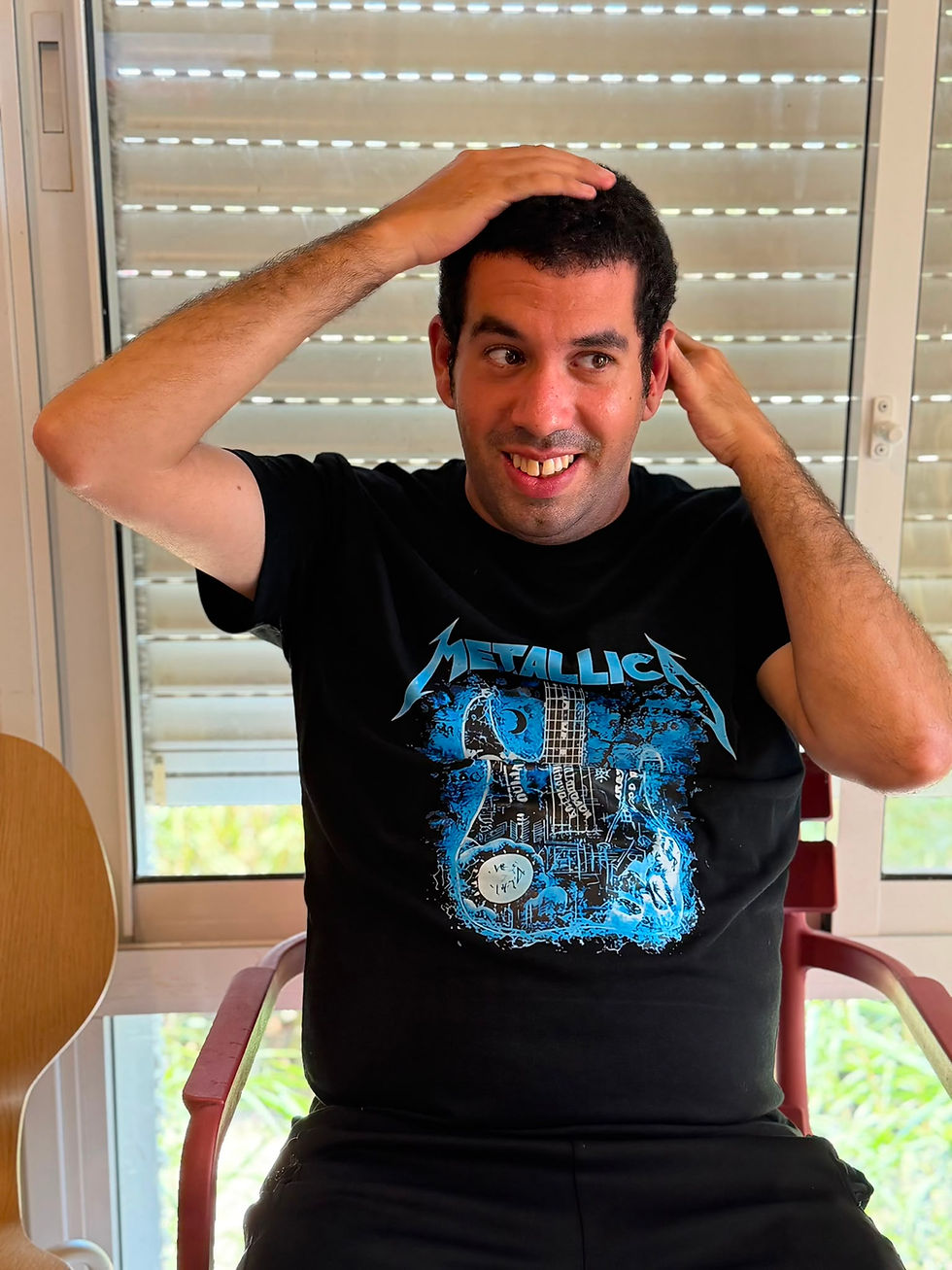
For many years, I believed Asaf lived in his own bubble, largely unaware of the people around him.
Until the age of twenty-three, Asaf had never had a friend.
He had classmates. He had people around him. At one point, he used to walk hand in hand with one of the girls in his class to the dining room. But that was as far as it went.
A year and a half ago, Asaf started attending Merchavim, a day centre where nonspeaking autistic young adults communicate through typing.
On the very first day, one of the members typed:
"I would like Asaf to be my friend."
I can still remember reading those words. Such a simple sentence, yet its meaning was enormous. My heart grew.
Not long afterwards, the group decided they wanted to have a pizza night together.
I was ridiculously excited.
Asaf had never been to a friend's house. Ever.
So I drove an hour and a half to pick him up from his hostel and take him to his friends house.
If an outsider had walked in that evening, they probably would have left wondering what all the excitement had been about.
There was almost no visible interaction.
One person sat in the garden.
One was on the patio.
One was in the kitchen.
One was in the lounge.
One was so overwhelmed that he spent much of the evening sitting in the car crying.
The following week, when they met again at Merchavim, each one of them typed how much they had enjoyed themselves.
They wanted to meet again.
That was the first time I realised that perhaps friendship doesn't always reveal itself through conversation or visible interaction.
Over the last year and a half, I've had the privilege of reading many of their conversations.
Mind-blowing doesn't begin to describe them.
The empathy they show each other.
The advice they give.
The concern they express when one of them is struggling.
The humour.
The kindness.
The depth.
It completely contradicts everything I was ever taught about autism.
I was told autistic people weren't interested in others.
I was told they weren't aware of the people around them.
I was told they lacked empathy and social understanding.
None of that matches what I've witnessed.
The love and understanding these young people have for one another is extraordinary.
One week, one of the group shared the challenges he was facing in his hostel. The support, encouragement and compassion the others offered him were unlike anything I had expected.

I wasn't watching a group of autistic young adults learning social skills.
I was watching friends looking after one another.
A few months ago, Asaf asked if he could invite his friends to the kibbutz.
He had the whole day planned.
"Dad will prepare the barbecue. Mum and Maya will show everyone around the kibbutz. Naama will come so that we can communicate. And I want to show them the *Safsal Hamekarev."
Safsal Hamekarev, literally means "the bench that brings people together", has a story of its own.
Earlier in the year, the local Bnei Akiva youth movement asked Asaf what activity he would like to do together during their week raising awareness about people with disabilities.
His answer surprised everyone.
He wanted to build a bench.
Not just any bench. A place where people could come, sit together and simply be with one another.

When he first asked to invite his friends to the kibbutz, I heard him. But life got in the way. The days were busy. The logistics were complicated. Everyone lived in different parts of the country. And somehow, it never happened.
Then, during one of his typing sessions, Asaf wrote:
"I want to invite my friends already to come. I ask my parents to do a BBQ and a walk. It's time already before it will already be too hot"
That got my attention. This mattered. His friendships mattered.
So we made it happen.
Five friends were able to come.
Along with their parents, because none of these young adults can simply arrange to meet independently.
We sat around the table. We ate.

We walked around the kibbutz. We sat together on the bench. They communicated through typing. They thanked me for organising the day. They spoke about how much they had enjoyed themselves.
Before long, they were already talking about the next time they could meet.
On one hand, I felt enormous joy.
Joy that Asaf has friends.
Joy that he wants to spend time with them.
Joy that he wants to welcome them into his world.
But alongside that joy was frustration.
Because they deserve the same freedom the rest of us take for granted.
The freedom to call a friend.
The freedom to make plans.
The freedom to decide, on a whim, to spend an afternoon together.
These young adults dream about travelling together.
They want to meet more often.
They simply want to spend time with one another.
But every visit depends on parents, transport, facilitators, schedules and geography.
Friendship has come naturally. Independence has not.
A few weeks ago, I asked Asaf how he would like to celebrate his birthday.
His answer came immediately.
"I'd like to invite my friends to the kibbutz for a pool party."
I smiled. Not because it was an extraordinary idea. Because it wasn't.
It was wonderfully ordinary.
For twenty-three years I wondered whether Asaf would ever have a friend.
Now, the thing he wants most for his birthday is simply to spend it with them.
I've discovered, is that friendship looks remarkably ordinary once people have a reliable way to communicate.
It looks like pizza nights. Barbecues. Pool parties. Supporting a friend who's having a difficult week.
Dreaming about travelling together.
Wanting to spend more time together.
Asaf has found a community where communication is possible.
Everything has changed. Not because Asaf changed.
But because, for the first time in his life, people could get to know him.
And now, when he asks me to organise another barbecue or another pool party, I don't see autism. I don't see disability.
I simply see a young man who wants to spend time with his friends.
And somehow, that feels wonderfully ordinary.


header.all-comments