What If We've Been Looking Through the Wrong Lens?
Updated: Jul 10

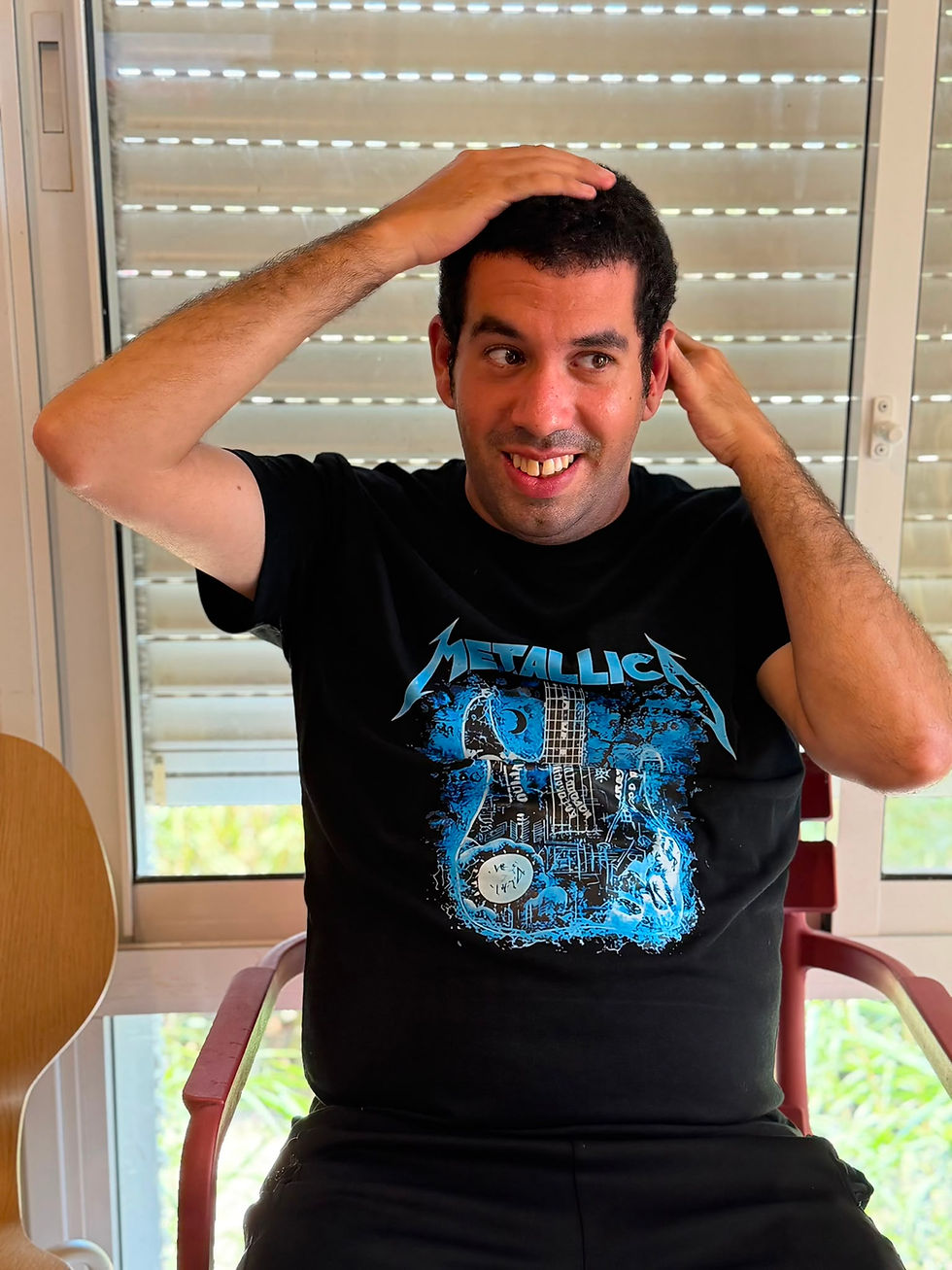
This week, after Asaf celebrated his 26th birthday, I sent a short video to Tami, the therapist who worked with us during the early days of communication through typing.
A few minutes later, she sent me a message.
"I remember Asaf's 20th birthday. You told me then that you didn't think he knew how old he was."
I read her message and stopped.
I don't remember saying it.
But I have no doubt that I did.
And I know exactly why.
For more than twenty years, I was told that Asaf understood the world like a very young child.
At first, it was the professionals' opinion.
Eventually, it became mine.
But looking back, I realize it was much more than a belief.
It was the lens through which I saw Asaf.
Even on the rare occasions when he did something that didn't fit that narrative, I found a way to explain it away.
I couldn't see beyond what I had been taught to see.
My mind interpreted almost everything through that one assumption.
After reading Tami's message, I found myself thinking about a conversation I'd recently had with another mother.
She told me how difficult it was to believe that her son was intelligent.
When she speaks to him, he shows no sign that he understands.
Sometimes he doesn't even acknowledge that she's there.
And I understood her completely.
Because I had been there too.
When someone doesn't respond, doesn't make eye contact, or gives no obvious sign of understanding, our minds naturally reach the same conclusion.
He doesn't understand.
But we never interpret what we see in a vacuum.
We see through the lens of our beliefs, our expectations, and our assumptions about what understanding is supposed to look like.
The conclusion feels logical.
It even feels true.
And yet, it may be completely wrong.
That is where presuming competence begins.
Not by ignoring what we see but by accepting that what we see may not be the whole story.
Even today, although I know Asaf is intelligent, there are moments when the old lens tries to return.
When he can't carry out a simple instruction, like closing the refrigerator door, what my eyes see can still be incredibly convincing.
But now I know better.
Asaf lives with apraxia.
His brain knows exactly what it wants to do.
His body doesn't always manage to do it.
He might go to make chocolate milk, come back carrying two bottles of milk, forget to close the refrigerator, then return with two glasses instead of one.
Someone watching from the outside sees confusion.
I have learned to see something different.
Almost every day, I remind Asaf of something that has become our mantra.
"Your brain is stronger than your body."
I remind him that the goal isn't to fight his body.
It's to help his brain find its way to his body, again and again.
And every time he overcomes another small challenge, I watch his belief in himself grow.
Looking back now, I realize the most painful part wasn't that I was wrong.
The most painful part was that I couldn't see another possibility.
Not because I didn't love Asaf.
But because I loved him so deeply, and trusted what I had been told for so many years.
That is the power of a belief repeated often enough.
It doesn't just shape what we think.
It shapes what we're able to see.
That is why I speak so passionately about presuming competence.
Not because I think parents or professionals don't care.
Quite the opposite.
I know how deeply they care.
Because I was one of them.
I know what it feels like to be completely convinced you're seeing someone as they really are, while unknowingly looking through the wrong lens.
If I, his mother, who loved him more than anyone else in the world, couldn't see beyond that lens...
How could I expect anyone else to?
The tragedy wasn't that Asaf lacked intelligence.
The tragedy was that we didn't know how to see him.
Presuming competence isn't easy.
It asks us to question what feels obvious.
To choose, again and again, to believe that what we see may be only a small part of the story.
Because sometimes intelligence isn't absent.
Sometimes it's simply hidden.
And the question is...
What are you missing because you're trusting only what you can see?


Comments